Human wayfinding
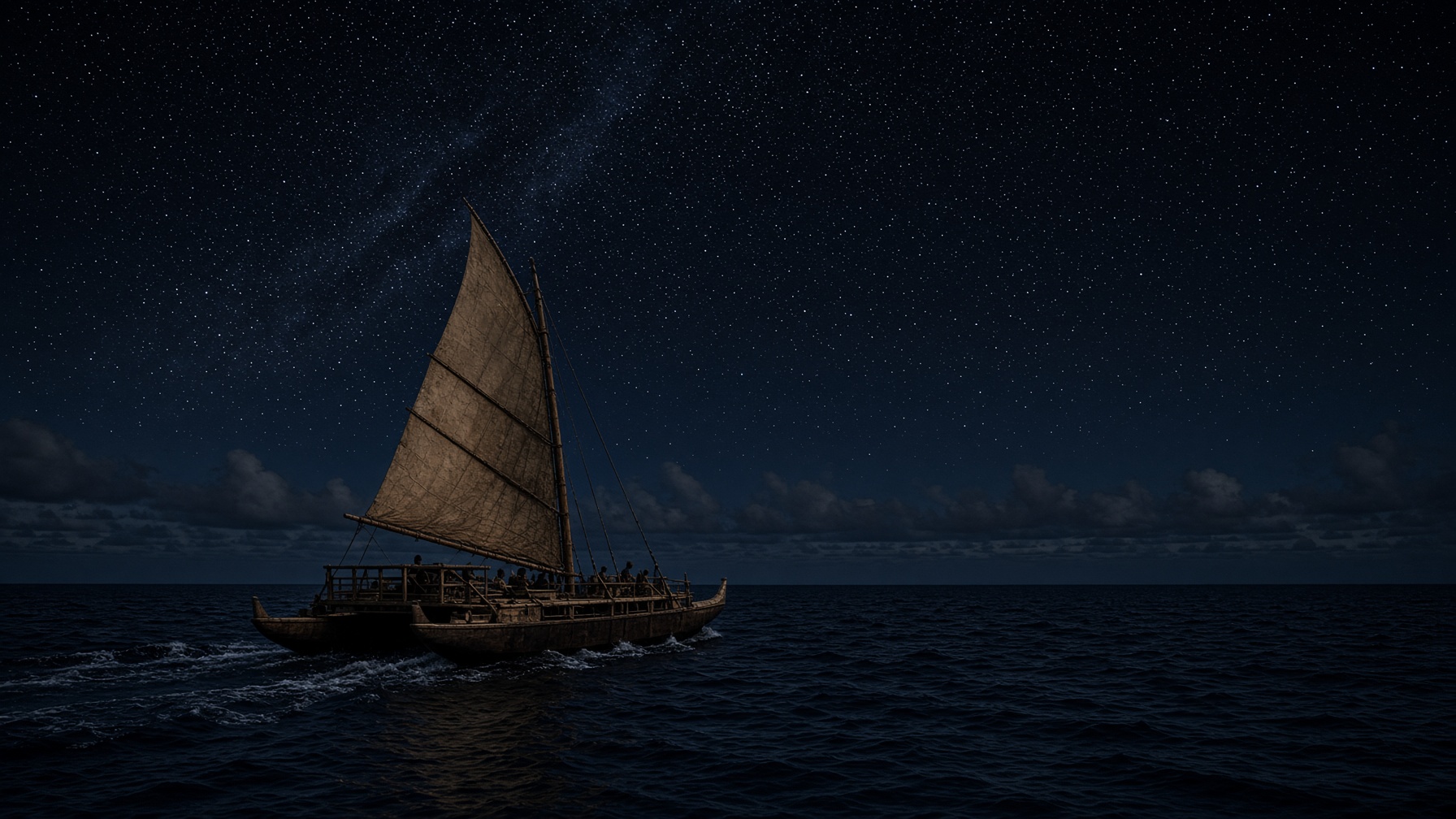
The Boat That Knew the Way
Can people learn to read the ocean the way a bird reads the sky?
Generated interpretation
Listen, or read
This story is not an animal story. It belongs here because orientation is also something people can practice.
In 1976 the voyaging canoe Hōkūleʻa sailed from Hawaiʻi toward Tahiti. There was no compass on the watch that mattered. There was a navigator.
His name was Pius Mau Piailug, of Satawal. He read stars, the shape of swells, the flight of birds, the color of clouds over unseen land.
What we know
Evidence, held lightly
We know
Hōkūleʻa voyaged from Hawaiʻi to Tahiti in 1976 with Mau Piailug navigating by non-instrument wayfinding.
Star compass, swell patterns, and wildlife cues are documented parts of the practice.
The evidence suggests
Sustained attention can make faint environmental structure usable.
We do not know yet
This page cannot carry the full knowledge. That lives with practitioners.
Try this
Try with a grown-up
Watch one horizon
At dusk, face the place the Sun went down. Notice the first star. Tomorrow, notice whether the wind has the same feel. You are not a navigator yet. You are practicing the beginning of attention.
Also nearby
A question to carry outside
Do humans also learn to read the world?