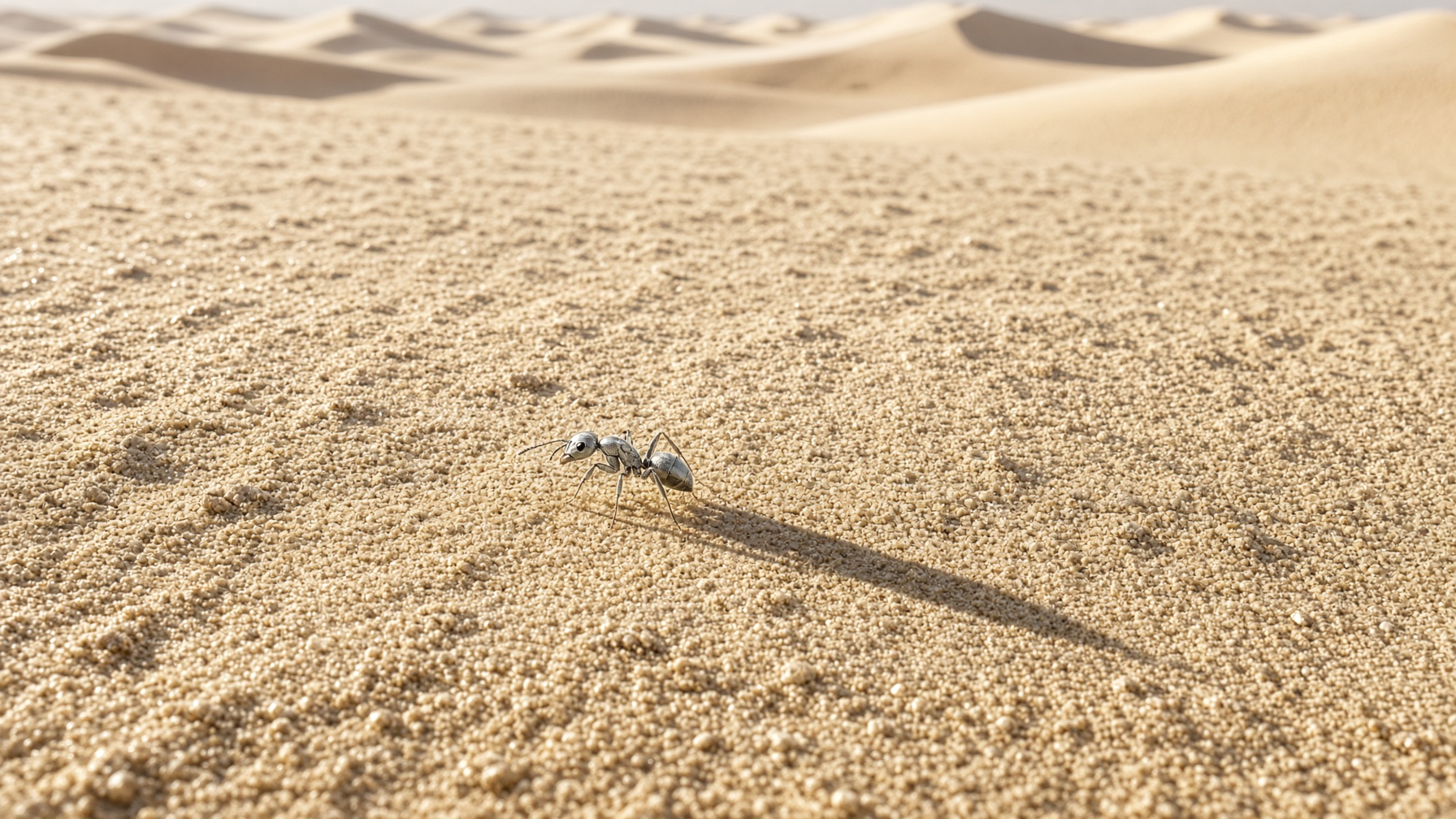
Sun and steps
The Ant in the Desert
With no trail to follow, how does an ant find a hole in the sand?
Generated interpretation
Listen, or read
On salt pans and dunes, a desert ant leaves the nest and hunts in a scribble.
When she finds food, the path home is almost a straight line.
The sand holds little scent in the heat. She is not following her own footsteps back.
What we know
Evidence, held lightly
We know
Cataglyphis ants use path integration: a Sun compass plus a stride odometer.
They detect polarized skylight.
The evidence suggests
A time-compensated Sun compass keeps the heading as the Sun moves.
We are still figuring this out
How the brain stores the home vector so compactly.
Try this
A child can try this
Walk a scribble, then point home
In a yard or room, walk a wiggly path. Stop. Point back to where you started before you look. Then look. Your body was counting too, less precisely than an ant.
Also nearby
A question to carry outside
Could you notice direction without a street sign?